Triinu Upkin on Self-Producing and Fringe Freedom
Singing ballerina Triinu Upkin opens up about self-producing, artistic freedom, and transitioning from grand ballet stages to the Fringe festival.
Triinu Upkin is one of the most distinctive artists on the Estonian theatre and music scene. Estonia's, and quite possibly the world's, only singing ballerina, she is an Estonian National Ballet dancer, singer-songwriter, director-choreographer, and dance semiotician who weaves all these facets together in her performances.
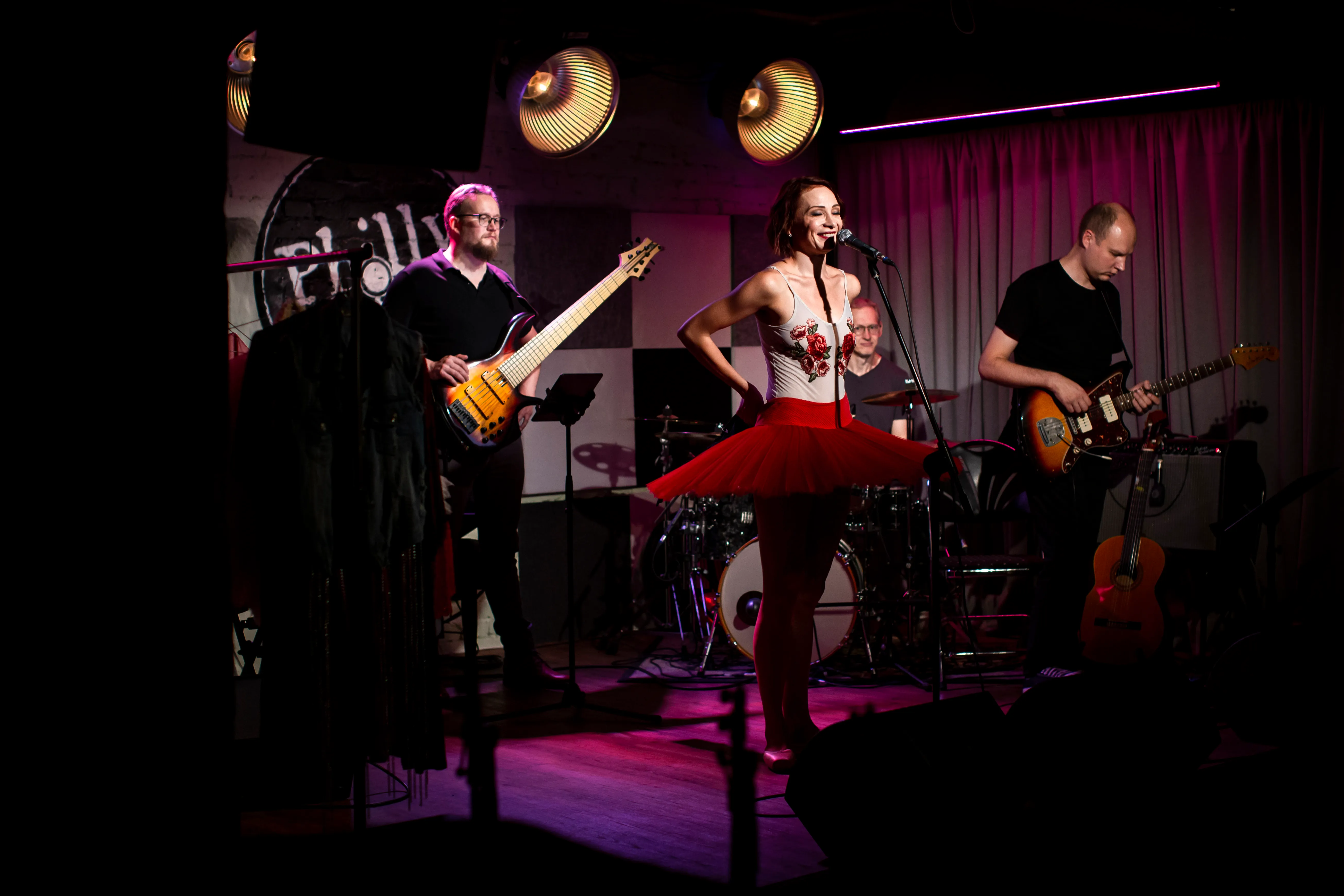
I sat with her and had a chat about the music industry, independent artists, and the Fringe festival.
Arashk Azizi: Having performed on both grand opera stages and independent venues, how do they compare? How has that physical proximity changed your relationship with the audience?
Triinu Upkin: Direct proximity to the audience is an immensely demanding situation. Having given over 1,000 performances on the big stage of the National Ballet, meeting the audience in more intimate, chamber-like settings has been exciting and frightening for me, but also a deeply formative and liberating experience. Being part of a large production on a grand stage means the responsibility is, on one hand, greater—a larger audience, broader reach, more colleagues you can't let down, competition, and higher stakes than yourself. On the other hand, because that responsibility is shared, it also feels smaller—mistakes can be offset by partners, no one is irreplaceable, and the caravan keeps moving. Doing my own smaller projects means taking full responsibility. I put myself in a position where there’s nowhere and no one to hide behind. It allows me to be more myself and step into whatever roles I choose, but I also have to deliver at the level required to carry it all. Direct proximity to the audience is also directly ruthless!
Arashk: Having participated in Fringe several times, how would you define this festival personally?
Triinu: For me, Fringe means genre freedom. Working as a ballet dancer, singer, songwriter, choreographer, and director puts me in a space that’s very hard to categorize—starting with questions like what genre my music is, or whether my show is a concert, a musical, a dance performance, stand-up, or a happening. It is incredibly liberating that at Fringe, it’s completely fine if my performance is all of those things at once: a Triinu show, no further explanation needed.
Arashk: What is your most memorable or unexpected Fringe moment, whether on stage or behind the scenes?
Triinu: Packed houses! And the warm, supportive atmosphere among the artists.
Arashk: Coming from a ballet company with full support teams handling logistics and PR, what was your steepest learning curve when becoming your own producer, marketer, and manager.
Triinu: Starting out as a musician alongside my career as a ballet dancer a few years earlier had already taught me my first lessons in self-promotion, so I wasn't diving in completely blind. But it's true that operating independently forces you to become self-reliant and grow up. The biggest hurdle to overcome was getting past (Estonian) modesty—if I don't put myself out there, promote my work, and share what I do, nobody will know about it, and nobody will come to the hall.
Arashk: How do you balance the physical demands of performing with the non-stop hustle of marketing, flyering, and ticket sales?
Triinu: Fortunately, I am physically in very strong condition, resilient, and not prone to self-pity. I do whatever needs to be done, and I'm fit enough to always give 100% on stage and enjoy it. If anything, I need someone to remind me to rest every now and then :)
Arashk: Has a performance or marketing experiment ever gone wrong at Fringe, and what did you learn from it?
Triinu: I've approached participating in Fringe with a fairly open mind and curiosity, so I can't say anything went drastically different from what I had planned. What I learned most was about myself—that I can adapt and manage in situations far outside my routine. And how valuable the foundation built over the years is when it comes to trusting myself and letting go in risky situations.
Arashk: Who would you recommend Fringe to, both as an artist and as an audience member?
Triinu: To the curious. Both artists and audience members.
Arashk: What advice would you give to classically trained artists who have creative ideas but feel intimidated by the uncurated Fringe scene?
Triinu: I wish them courage. What’s the worst that could happen? Eternal shame? Haha! That last part is a joke, of course. Putting yourself out there with a creative idea and executing it always leaves an artist vulnerable. But if you don't do it, nothing happens. In that sense, Fringe is actually one of the safest places to test wild ideas, because the festival itself acts as a protective shell and support system for the performer.
Arashk: Complete this sentence: "An artist should perform at Fringe at least once because..."
Triinu: It is a relentless mirror showing your current state as an artist.