Theatre at Tallinn Fringe 2026: Beyond the Traditional Stage
Explore theatre at Tallinn Fringe 2026, from Kafka and Estonian drama to improvisation, physical theatre, comedy and wordless performance.
Theatre at Tallinn Fringe Festival rarely stays neatly inside the boundaries of what we traditionally call theatre.
Across the 31 days of the 2026 festival, from 18 August to 18 September, the programme moved between monologue, literary adaptation, improvisation, physical theatre, comedy, clowning and full-scale contemporary productions. Some performances depended almost entirely on language; others abandoned spoken words altogether. International artists shared the programme with established Estonian theatres, while intimate one-person shows appeared alongside larger ensemble productions.
That variety is partly built into the structure of Tallinn Fringe itself. The festival is open-access rather than centrally curated: artists and venues bring performances into the programme independently. The result is a theatre programme that feels less like a single artistic statement and more like a collection of different ideas about what theatre can be.
From Kafka to Sholom Aleichem#
Some of the most recognisable theatrical traditions appeared through literature.
Robert McNamara brought Franz Kafka to the festival with A Report to an Academy, a one-man production by SCENA Theatre adapted from Kafka’s short story.
McNamara plays Red Peter, an ape who has learned to become human as a means of survival. The audience itself becomes the “academy” to whom he delivers his report, turning Kafka’s strange transformation story into a direct encounter between performer and spectator.
Presented in English across four performances from 24 to 27 August, the production moved between Heldeke! and IMPEERIUM improteater ja teatrisaal.
Another literary tradition arrived from Ukraine.
In Three Loves, Kyiv actor Sviatoslav Fechtel presented a solo performance based on stories by Sholom Aleichem. The English-language production combined three stories around love, hope and human nature, using relatively simple theatrical tools: a performer, language, imagination and storytelling.
The show ran four times between 20 and 25 August, bringing a very different kind of theatrical intimacy to the programme.
The contrast between the two is revealing. One takes Kafka’s unsettling tale of adaptation and identity; the other draws on the humour and humanity of Sholom Aleichem. Both, however, return theatre to one of its oldest foundations: a person standing before an audience and telling a story.
What Happens When the Script Disappears?#
Elsewhere, the festival moved in the opposite direction.
In The Supreme Art of Improvisation, Danish performer Caspar Schjelbred opened up the mechanics of improvisational theatre itself.
Rather than hiding the process behind a finished scene, Schjelbred made the process part of the performance. Split-second decisions, impulses, uncertainty and character creation were exposed in front of the audience, with theatrical mechanisms briefly identified and then demonstrated live.
The audience was even invited to try an exercise from their seats.
Schjelbred’s background combines improvisation with clowning, mime and physical acting, making the show as much an exploration of how performers think and react as a conventional theatre performance.
His presence at the festival also extended beyond performance. Impro Supreme Workshops offered experienced performers two four-hour sessions centred on physical improvisation, encouraging participants to work from movement, space and instinct before intellectual decisions take over. Both workshops sold out.
Here theatre was not only something to watch. It became something to take apart, examine and practise.
Theatre Without Words#
Then there was Sexy Ghost Boy.
George Fenn’s award-winning New Zealand production sits somewhere between theatre, clowning, comedy, burlesque and physical performance. Most importantly, it does all of this without spoken dialogue.
The hour-long show uses physical interaction to explore the rituals, anxieties and strange behaviours surrounding sex. A small amount of written material is provided in English and Estonian, but the performance itself is essentially wordless.
The production first appeared at Kanuti Gildi SAAL in August and later returned for two additional performances at Heldeke! on 17 and 18 September, carrying this particularly difficult-to-categorise piece almost to the end of the festival.
It also demonstrates one of the advantages of physical theatre at an international festival.
Language can create borders. Gesture rarely needs translation.
Comedy, Theatre and the Space Between Them#
Fringe theatre often becomes most interesting when genres stop behaving properly.
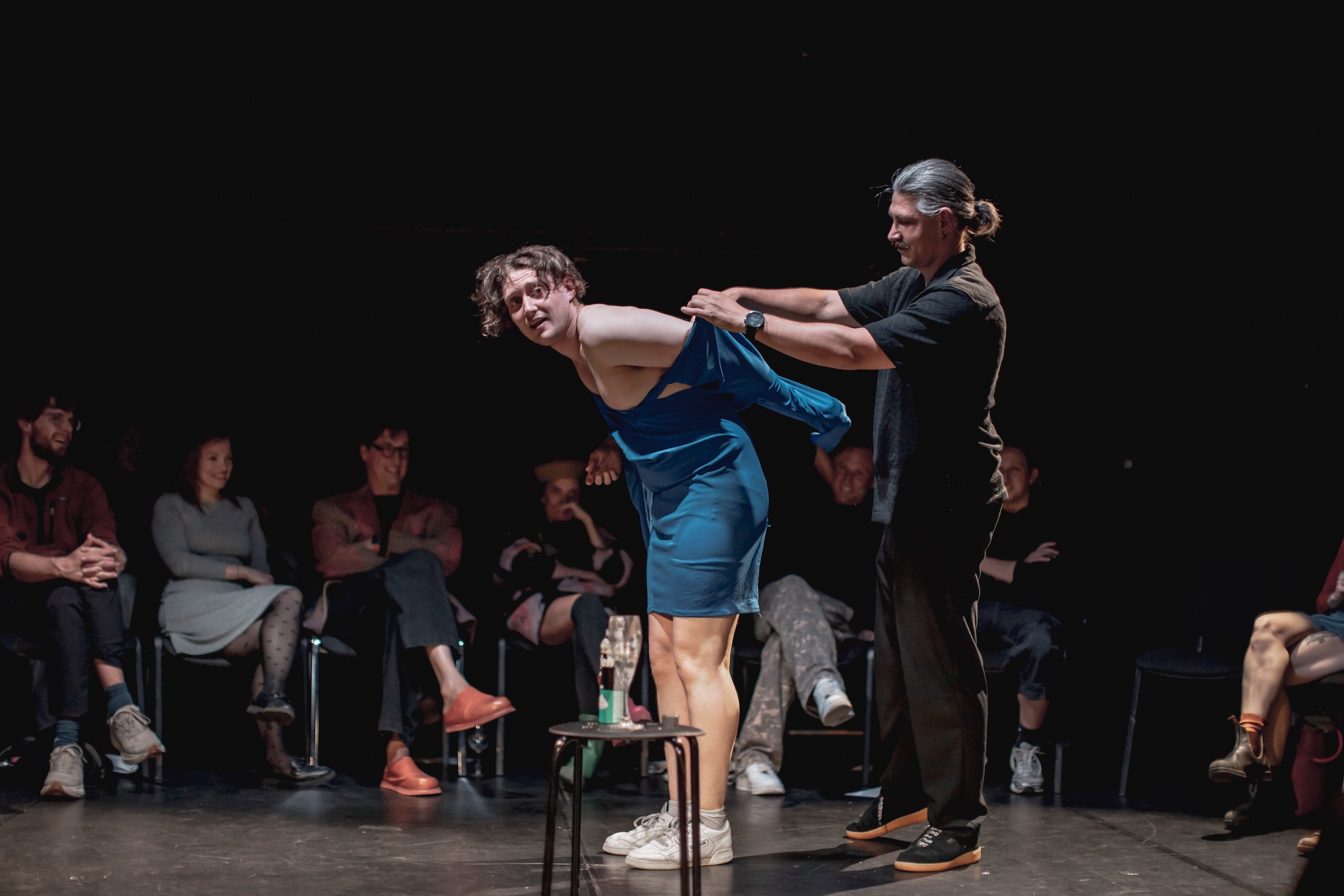
Wait, What is This?, performed by Lydia Keating and John Harper, describes itself as a comic two-hander built around rhyme, chaotic plotting and iambic wordplay. It is simultaneously listed as theatre, comedy and cabaret — a classification that probably tells us more about Fringe than forcing it into any single genre ever could.
The same genre-crossing quality appeared in Los Monroe, where two grown men become convinced that they are Marilyn Monroe’s secret sons. What begins with an absurd premise becomes an English-language theatrical comedy centred on two characters attempting to persuade everyone else that their theory is true.
And Let’s Try Gay, from Italian theatre company Underluminal, mixes comedy with a more serious examination of male friendship, insecurity, sexuality and the ways men struggle to express emotion.
The production had already travelled through fringe and theatre festivals in Colchester, Edinburgh, Dublin, Milan, Barcelona and London before arriving in Tallinn, showing another side of Fringe theatre: relatively small productions capable of moving internationally from festival to festival.
These are plays, certainly.
But they are also comedy shows, experiments in form and examples of why the line between Tallinn Fringe’s categories is often intentionally porous.
Estonian Theatre Inside the Fringe#
The programme was not composed only of touring international artists.
One of its largest productions came from Von Krahli teater with Triin Ruumet’s Ma tahan uskuda.
Rather than the compact one-hour format common to many Fringe productions, Ma tahan uskuda runs for approximately two hours and twenty minutes with an interval and features a larger creative and performing team.
The Estonian-language production takes the world of reality dating television as its starting point: cameras, confessionals, successive dates and the construction of lives for an audience. Gradually, however, that manufactured reality begins to destabilise, forcing its characters to confront the difference between performing a life and actually living one.
Its six festival performances between 4 and 18 September sold out.
The presence of a production like Ma tahan uskuda also widens the meaning of theatre within Tallinn Fringe. The festival does not exist only as a platform for touring solo acts or experimental newcomers. An established Tallinn theatre can occupy the same programme as an improvised solo, a visiting Ukrainian storyteller or a wordless New Zealand clown performance.
That mixture is part of the point.
English, Estonian and a Theatre That Travels#
Language plays an interesting role in the theatre programme.
Many of the visiting productions were performed in English: A Report to an Academy, Three Loves, The Supreme Art of Improvisation, Los Monroe and Let’s Try Gay all allowed international artists and Tallinn audiences to meet through a shared theatrical language.
At the same time, Ma tahan uskuda represented contemporary Estonian-language theatre within the festival.
And then a production such as Sexy Ghost Boy largely removed the linguistic question altogether.
Tallinn Fringe itself highlights this accessibility: many of its theatre and comedy performances are presented in English, while visual and physical work can cross linguistic borders more easily still.
For an international city festival, that matters.
Theatre does not need to become culturally anonymous in order to travel. It simply finds different ways to communicate.
One Festival, Many Definitions of Theatre#
Perhaps the most useful thing about looking at theatre across Tallinn Fringe 2026 is how quickly the word itself begins to expand.
It can mean Robert McNamara alone onstage confronting an audience through Kafka.
It can mean a Ukrainian actor telling Sholom Aleichem’s stories.
It can mean an improviser creating characters before our eyes.
It can mean two performers speaking in relentless rhyme.
It can mean a full Estonian production at Von Krahl.
And it can mean George Fenn saying almost nothing at all.
Across Tallinn Fringe, theatre moved from text to body, from literature to improvisation, from intimate rooms to established theatre spaces, and from quiet storytelling to theatrical absurdity.
That is particularly fitting for a festival without a centrally curated programme. Tallinn Fringe does not have to decide which of these approaches represents theatre most accurately. Its structure allows them to exist beside one another.
For the audience, the result is a month in which going to “the theatre” might mean something completely different from one evening to the next.
And perhaps that uncertainty is one of the best reasons to go.