Comedy at Tallinn Fringe 2026: A Month of Laughter
Discover comedy at Tallinn Fringe 2026: a month of stand-up, satire, clowning and absurdity in English, Estonian, Russian and beyond.
For 31 days, Tallinn Fringe Festival turns the city into a stage for independent performance, and few parts of the programme demonstrate the festival’s variety quite as clearly as comedy. From 18 August to 18 September 2026, comedy appears throughout the festival in different languages, venues and forms: traditional stand-up sits beside absurdist theatre, audience participation, improv, clowning, satire and performances that barely need words at all.
There is no single definition of what a comedy show at Tallinn Fringe should look like. And that is precisely the point.
From Stand-Up to the Completely Absurd#
The comedy programme began on the festival's opening night with Please The People: Comedy Challenge Show, hosted by Ana Falcon. Rather than a conventional sequence of prepared stand-up sets, three comedians were thrown into challenges, bizarre problems and even a dance battle, with the audience ultimately deciding the winner. It set an appropriate tone for a festival where comedy can become a game almost as easily as it can become a monologue.

At the other end of the festival, Liam Duffy takes the concept of an interactive game show in an even stranger direction with Pickle Based Game Show: Crunchy, Briny and Chaotic. Two audience members are invited to compete in a series of pickle-related challenges testing their senses, perseverance and, presumably, tolerance for brine. The show arrives in Tallinn after appearances at several European fringe festivals, including Edinburgh, Gothenburg and FinFringe.
It is difficult to find a better illustration of the Fringe principle: if someone has found a way to turn pickles into an hour of live comedy, there is probably room for it here.
But the programme also includes comedy built around unexpectedly specialised subjects. Excel Comedy & Mathem-antics by David Benaim turns spreadsheets, mathematics and office life into material for a combination of stand-up, storytelling and live Excel demonstrations. It is comedy for spreadsheet experts and casual users alike — perhaps one of the rare occasions when opening Excel after work might actually improve your evening.
Comedy Can Be Personal, Political and Uncomfortable#
Not everything in the programme is designed simply as a sequence of quick laughs.
In IS THIS WHAT YOU WANTED?, Helsinki-based Canadian-Finnish performer happeningfish mixes stand-up with queer performance, politics and intensely personal material. Relationships, emotional labour, self-deprecation, transgender experience and the desire to be loved all become part of a show that deliberately moves between philosophical ideas and dirty jokes. The performance itself is also connected to happeningfish's practice-based PhD research into transgender stand-up comedy and laughter as activism.
That ability to move between humour and more serious territory can also be found closer to home. Tallinn-based comedian Aleksandr Popov appears repeatedly across the festival with autobiographical stand-up performed in different languages. Hospital Hullabaloo turns a frightening encounter with failing health and masculinity into an Estonian-language comedy, while 50 Shades of Bouncer draws on more than two decades of nightlife, work and personal history. Popov has also performed material in Russian during the festival, including ПРОПАШИЙ ПЕДАГОГ, about his unlikely transition from nightclub doorman to teacher.
Comedy here becomes storytelling: sometimes ridiculous, sometimes uncomfortable, sometimes surprisingly vulnerable.
English, Estonian, Russian — and No Language at All#
The international nature of Tallinn Fringe is particularly visible in its comedy programme.
English-language comedy runs throughout the month. Old Town English Open Mic by Comedy Estonia, for example, has taken place every Wednesday during the festival, creating space for both experienced comedians testing new material and newcomers stepping onto a stand-up stage for the first time.
Estonian comedy is equally part of the programme, with Comedy Estonia's local open mics and performers such as Aleksandr Popov giving audiences a distinctly local alternative to the international English-language shows. The programme even crosses into Russian, making the comedy strand linguistically broader than a typical international touring programme.
And sometimes language disappears altogether.
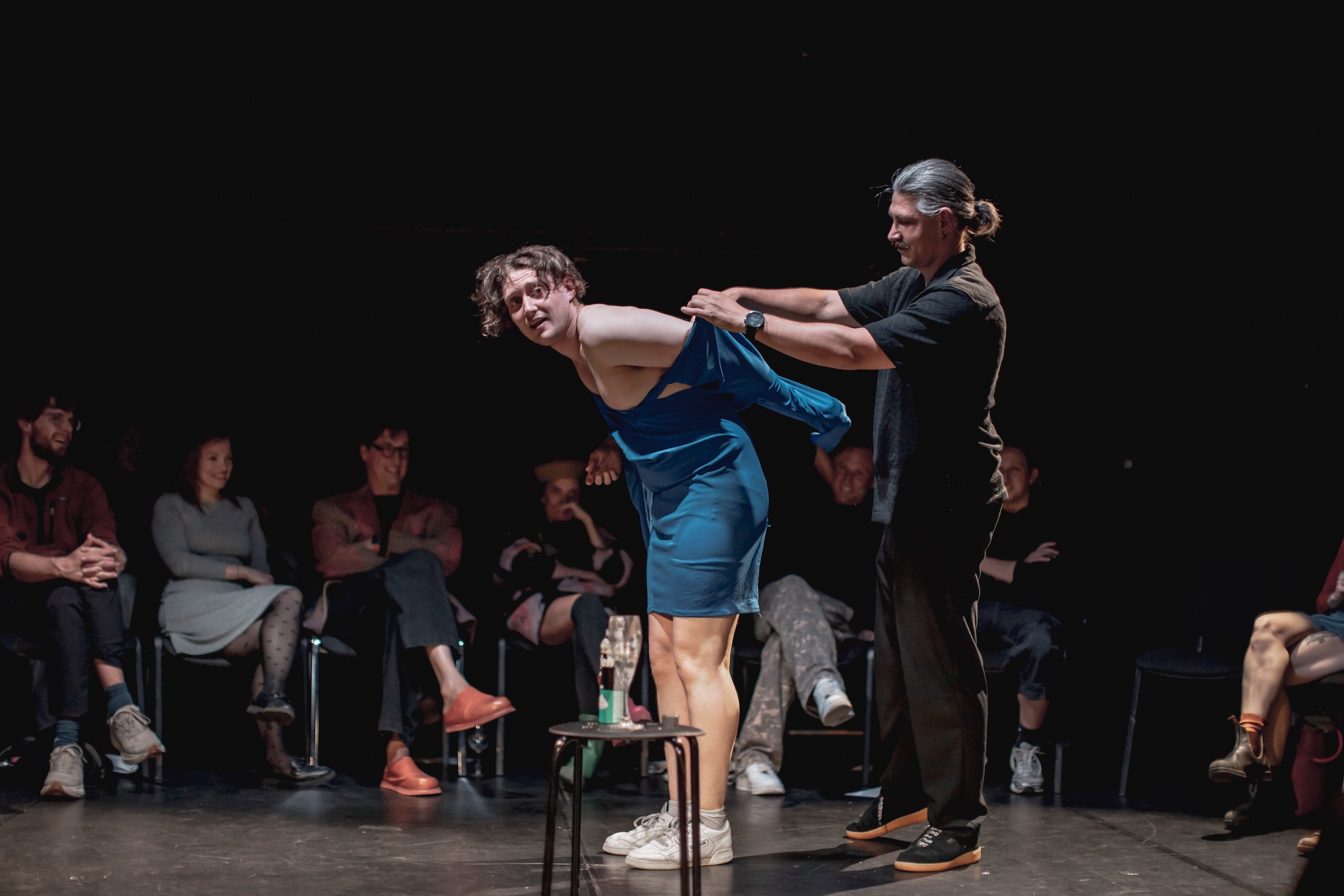
George Fenn's Sexy Ghost Boy is listed simultaneously as comedy, theatre and cabaret, yet uses no spoken language. Combining clowning and burlesque, the wordless performance examines the tiny rituals and neuroses surrounding sex through physical comedy. It is a useful reminder that comedy does not necessarily begin with someone standing behind a microphone.
International Comedy Comes to Tallinn#
Some performances bring particularly distinctive international styles to the programme.
The Japanese company GUMBO's Are You Lovin' It?, performed by Kayo Tamura, Nono Miyasaka and Ryo Nishihara, takes audiences into the surreal world of “WacDonalds”. The award-winning production combines Dadaist clowning, cartoon-like physicality and political satire to take aim at fast-food capitalism and globalisation. It has already collected awards across fringe festivals in seven countries before reaching Tallinn.
Then there is old., an English-language stand-up hour from New Zealand comedian Snap, built around ageing, mortality and the uncomfortable discovery that one's thirties may already feel suspiciously old. Its first Tallinn performance sold out.
Elsewhere, Too Hot for Sauna brings together Sandra Tiitson, Jana Levitina, Sille-Kadri Simer and Tatiana Akopova for an English-language stand-up show following performances by the group in Berlin, Brussels and Luxembourg.
The result is not simply international comedy imported into Tallinn, but a mixture of visiting artists and Estonia's own increasingly multilingual comedy scene sharing the same festival.
One Month, Many Ways to Be Funny#
What makes the comedy programme of Tallinn Fringe Festival 2026 interesting is ultimately not any single performer. It is the distance between them.
A spreadsheet show can be followed by queer political stand-up. An autobiographical story about working as a nightclub bouncer can share a festival with Japanese Dadaist clowning. A traditional open mic can coexist with a pickle game show. Some comedians rely almost entirely on language; another can perform an hour without speaking at all.
And the mood changes with them. The programme moves from silly to satirical, intimate to chaotic, philosophical to deliberately filthy, carefully written stand-up to performances where audience participation makes the outcome unpredictable.
Even in the final days, the range continues. Teenagers and Old People by Benjamin Heckscher brings English-language stand-up about youth, technology and “existential nightmares”, while Sexy Ghost Boy, Are You Lovin' It?, local open mics and several of Popov's shows carry comedy almost all the way to the festival's closing night on 18 September.
That month-long spread is important. Comedy at Tallinn Fringe is not a separate weekend or a small subsection of a larger programme. It runs through the festival from its opening evening to its final days.
For audiences, that means there is no single answer to the question, “What kind of comedy is at Tallinn Fringe?”
Stand-up, certainly.
But also clowning, improv, satire, theatre, storytelling, game shows, experiments, politics, personal confession, spreadsheets, ghosts; and, apparently, pickles.
That sounds much more like Fringe.